Just had to share this one
Bookworm on Jul 16 2008 at 4:48 pm | Filed under: Uncategorized
I had a birthday while I was away on vacation, so my mother only just got a chance to give me a birthday gift — and what a gift she gave me. I’ve long coveted a photograph she sat for, in Jerusalem, in December 1945, when she was 22 years old. That date is significant because it was a mere 4.5 months after she was liberated from concentration camp in Indonesia (where she’d been imprisoned since December 1941). You can learn more about Tjideng, one of the camps in which she was held, here.
Mom always claims that, when she looks as the picture, she can still see the faint puffiness in her face that is a residual of the bloating that occurs when one is dying from starvation. I don’t see that. To me she’s just beautiful. As you look at it, use a little imagination and add some color: pale blond hair, golden tanned skin, and ice blue eyes.
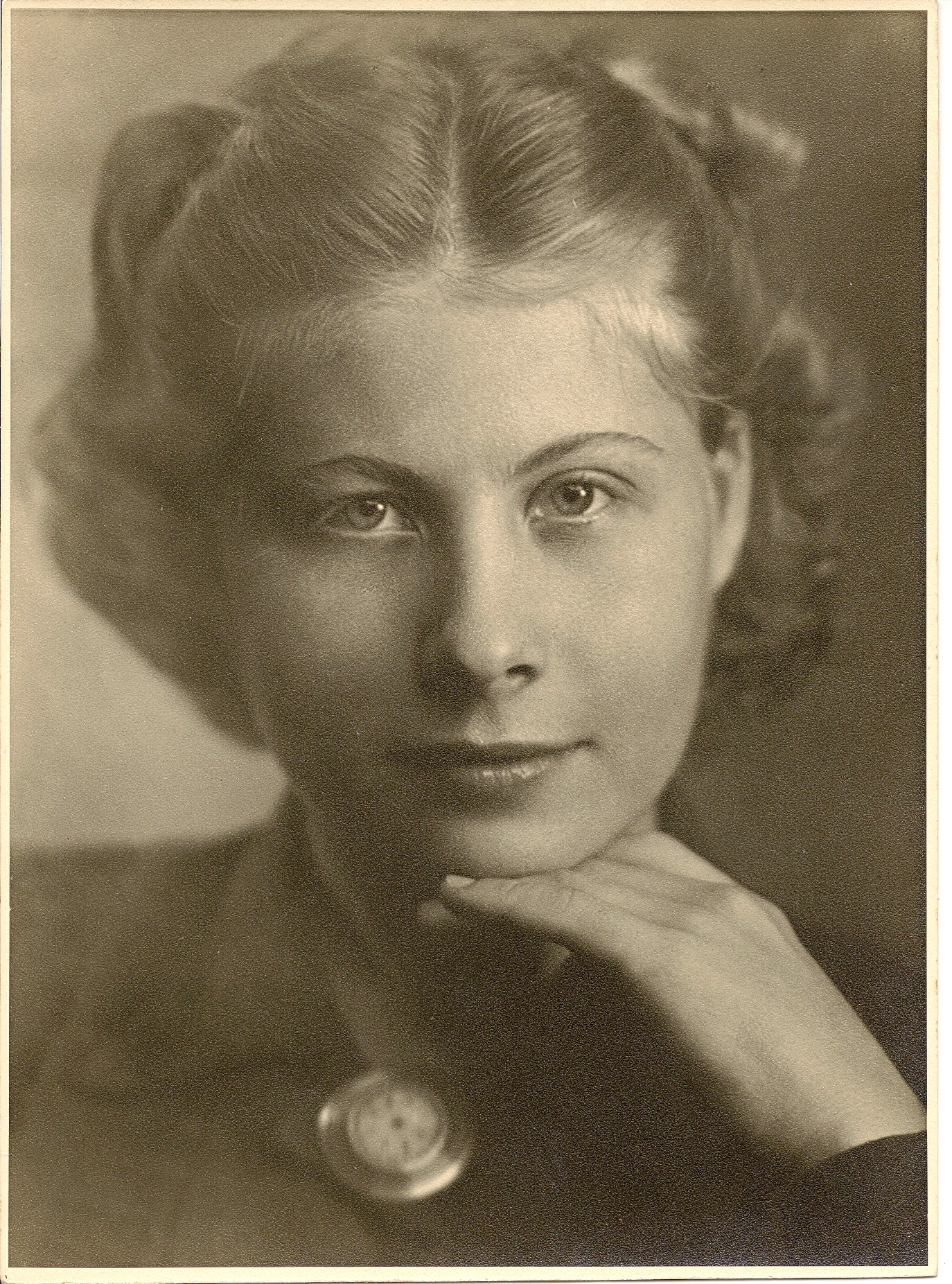
UPDATE: My husband, who is not much given to compliments, saw this photo for this first time today and announced “It looks like you.” I think he’s wrong (I look too much like my Dad, not to mention being more than 20 years older than that girl in the photograph), but I was flattered nevertheless.
Sphere: Related Content
Email This Post To A Friend
24 Responses to “Just had to share this one”
Leave a Reply
You must be logged in to post a comment.


My son says your mom was beautiful; I agree. He wanted to know more about how she ended up in Tjideng. He’s always interested in WWII history. I remember you posted about it, but can’t seem to find it.
Remarkable.
Wow, Bookworm, what a treasure. Your mom is so beautiful!
I just love old photos - they allow a glimpse into another time. But this photo is particularly wonderful, given her history.
Thanks for sharing!
Deana
One other thing - my grandpa died a little over a year ago. He had the same coloring as your mom. So handsome. And with the most beautiful ice blue eyes. You just don’t forget that eye color.
Deana
I’ve scattered bits and pieces of the war history of families and friends all over my blog (two of my favorites are here and here), but I don’t think I ever told the story of how my Mom ended up in camp. Here’s the short version.
My Mom’s parents, shortly before her birth, moved to the Dutch East Indies (modern Indonesia), because my grandfather got a job there. Although Mom was born in Java, the family left while she was still a very small child, and returned to Holland. After a few years in Holland, they relocated to Austria and then moved to Palestine (since my grandfather, while an atheist, was an ardent Zionist).
My Mom was living in Tel Aviv when the war broke out. Her Dad, an architect, worked with the British high command designing buildings. He became friends with some of the officers, who told him that they were not optimistic about holding out against Rommel’s forces. Had the British failed, it would of course have been a bloodbath in Palestine, with both Nazis and Arabs decimating the Jewish population.
My grandfather therefore got what seemed like a bright idea: he sent my Mom and her sister to Java, a country he knew well and that he believed was well out of the war. They arrived in June 1941. Six months later: Pearl Harbor. A few days after that (which is something most Americans don’t know), the Japanese invaded Indonesia, and instantly set about relocating and then imprisoning the Dutch population.
From 1942 through war’s end, my Mom and her sister were interned in a variety of camps, with Tjideng being the best known. They were liberated after Truman dropped the bomb. As I’ve noted before, I therefore have much reason to be grateful for that decision (a feeling shared by the 40,000 US forces who did not have to die taking Japan, and by their descendants too).
Stunning. She looks very Dutch.
She does, doesn’t she? In fact, there’s no Dutch blood in her but, on her mother’s side, plenty of very Germanic blood. The family had lived in Northern Germany trading cities (the Hanseatic League) for centuries. My grandmother was another white blond, although not as pretty as my Mom, and my great aunt was a staggering beauty with perfectly chiseled features, silver hair and yellow eyes.
On her Dad’s side, she was Hungarian Jewish — and that family line was very Jewish looking — going back to just after the expulsion from Spain in 1492.
She’s beautiful, Bookworm.
She’s lovely! And it reminds me that I need to thank you for recommending Leon Uris’ Exodus some time ago. I’m reading it now, and wow!
(As you can see, I was finally able to log on to comment!)
Beautiful and very classy.
Beautiful was she. I imagine some of that beauty has been preserved through the years.
Going to Indonesia to flee war reminds me of the story of the parents of a Porteno (Buenos Aires resident) I worked with. His parents were Hungarian. His father was a diplomat at the Hungarian embassy in Tokyo during WW2, and when Hungary turned Communist, the family needed to find a country to go to. His parents decided that Argentina was a safe and prosperous place.
Unfortunately, while it may have been safe and prosperous during the 1940s, Argentina’s subsequent track record made it much less safe and prosperous in the years to come. Any port in a storm, and while some ports may turn out to be better than others, in most instances they are a better alternative to the stormy sea.
What a marvelous picture, your family’s story as well.
It reminds me of pictures of my family in 1880 arriving here in the US and one truth; America remains the one place where the downtrodden can find a home and prosper.
So it’s true. The beauty we remember of the past really was that beautiful. And I am sure that beauty is preserved.
Happy Birthday, BW.
Al
That is a lovely picture. Tell Mom she was a cutie! Maybe she still is.
Totally off topic…
Mrs HH…
Looked on your blog for a way to contact you, but no could find.
If your son has an interest in WWII, you might want to check out ebay for “The Great Courses”…there’s a History of WWII on auction there. The Great Courses are put out by http://www.teach12.com/teach12.asp?ai=14265
Even their sales are pretty pricey. I’ve been shopping ebay in hopes of finding some somewhat less expensive alternatives, and have bought a couple at fairly low prices. ($20 - $30 range).
Bookworm, son and I read your reply. The tale has all the hallmarks of an ironic tragedy. I dare Will Shakespeare to do better. God bless your mother. I’m sorry she suffered so much when she was still so young. Perhaps I’m wrong, but I see a strong will and a bit of “Dare me” behind those eyes.
Thank you for sharing her photo and history; it was a privilege. Happy Belated Birthday.
Suek, thanks for the tip. I guess I should add some contact info to my blog.
Your Hottie mom’s story reminds me a bit of a story from our own Civil War (which was a rebellion, not a civil war). I wish I could remember the details better, so forgive me, but here goes!
A farmer an his family got caught in the middle of the first (2nd?) Battle of Bull Run — sometimes known in Southern parts as The Great Skedaddle. Wanting a more peaceful place to live, they moved to another farm which farmhouse ended up being some general’s headquarters, or the house where a great armistice — or something like that — took place. Perhaps someone with a better memory can remind me.
Nowhere near as harrowing as your Mom’s story, but an interesting footnote.
On a different point, waayyy off topic, this is an elegant example of classic portraiture, and shows what you can do with only two lights, slow film, and a big old wooden camera (I’m a photographer).
The pose is a perfect Full Face, which many faces can’t manage either because they’re fat, or quite asymmetrical. Your mom’s face is perfectly symmetrical. There is only a slight feminine tilt of the head, so I suspect your mom, though very feminine, has a backbone of steel.
The lighting is what we call Rembrandt Lighting. The left side of her face is fully lit, but the light just kisses her right cheek, and it is fully enclosed by shadow. However, her right eye IS fully lit, but yet is ALSO enclosed in shadow. Whether that was done in the studio, or later in retouching — I suspect studio — it is elegant, subtle, and just right. You don’t get that quality at the mall.
The camera’s Point of View is nose level, or slightly lower which gives her full presence, rather than a higher POV which would literally look down on her. The composition using her hand gives a subtle diagonal of light foreground leading right to her face. Your eye is powerfully drawn to her face, and held there.
Notice also that the background is light where her face is dark, and dark where her face is light. This gives both a feeling of depth, and an internal frame to her face. As you can see here, it doesn’t really need an actual frame. The BG light is also low, falling off toward the top, whereas the Main Light is slightly higher, at the 3 o’clock position. Look; you can see it in her eyes.
Speaking of her eyes. Do you see that her pupils are nicely dilated as they would be indoors in room light, as opposed to under bright studio lights? That gives the VERY subtle impression that she likes what she’s seeing.
Finally, the print itself is not stark, cold Black-black and white. The paper has nice warmish dark tones appropriate to the subject.
There are other good things, like the focus fall off, but you get the idea.
This is a First Class job. I’m stealing it for my portrait file.
You’re right, Bill. There are other photos from my Mom’s young days showing that this was no studio trick — she was beautiful, and her friends often compared her to Ingrid Bergman. This photo, though, has that little something extra, and I find fascinating the way you’ve analyzed the different tricks the photographer used to create the special quality that goes beyond just taking a picture of a pretty face.
@Bill Smith
“Your Hottie mom’s story reminds me a bit of a story from our own Civil War (which was a rebellion, not a civil war). I wish I could remember the details better, so forgive me, but here goes! A farmer an his family got caught in the middle of the first (2nd?) Battle of Bull Run — sometimes known in Southern parts as The Great Skedaddle.Wanting a more peaceful place to live, they moved to another farm which farmhouse ended up being some general’s headquarters, or the house where a great armistice — or something like that — took place. Perhaps someone with a better memory can remind ”
That rang a bell with me. I believe I found that out from the Ken Burns Civil War series.
From Wikipedia.
I first Googled “McLean Appomatox.”
@Bill Smith
“Your Hottie mom’s story reminds me a bit of a story from our own Civil War (which was a rebellion, not a civil war). I wish I could remember the details better, so forgive me, but here goes! A farmer an his family got caught in the middle of the first (2nd?) Battle of Bull Run — sometimes known in Southern parts as The Great Skedaddle.Wanting a more peaceful place to live, they moved to another farm which farmhouse ended up being some general’s headquarters, or the house where a great armistice — or something like that — took place. Perhaps someone with a better memory can remind ”
That rang a bell with me. I believe I found that out from the Ken Burns Civil War series.
From Wikipedia. I first Googled “McLean Appomatox” to find the appropriate Wikipedia article.
“Because the first Battle of Bull Run, fought on July 21, 1861, took place on the McLean farm farther north in Virginia, it can be said that the Civil War started in McLean’s backyard in 1861 and ended in his parlor in 1865 (neither event, however, marked the true beginning or ending of hostilities).
McLean was a retired major in the Virginia militia. He was too old to enlist at the outbreak of the Civil War and decided to move to Appomattox Court House in order to get away from the Civil War (after the war, he liked to portray himself as having moved because he was a peace-loving man, but the reality is that during the war, he made a small fortune running sugar through the Union blockade; he simply wanted to carry on this lucrative business without the interference that nearby hostilities would cause). Nonetheless, on April 9, 1865, the war came back to McLean when General Robert E. Lee surrendered to Lieutenant General Ulysses S. Grant at his house.” I first Googled “McLean Appomatox.”
Because the blankety blank @!#$$%#$$# %$%$#@#$%$%$%Q@W$%$%$# software kept eating my posting with HTNL tags, I am leaving them out. I tried posting yesterday afternoon with only 1) a link, 2) a blockquote, and 3) italics. No go. I cut out blockquote and italics this morning. Software still ate it. So, no links. Nothing. If you want to find the Wikipedia article I am quoting, you should be able to find it, as I have given sufficient hints how to find it.
excuse me HTML tags.
Wow. Gringo, THANKS! That’s exactky the story I was trying to recall.