Remembering D-Day
Bookworm on Jun 06 2008 at 7:01 am | Filed under: Uncategorized
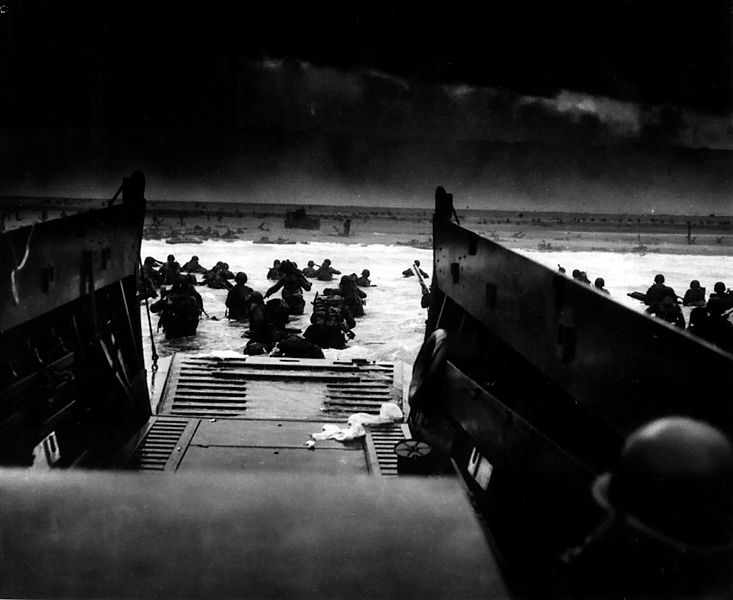
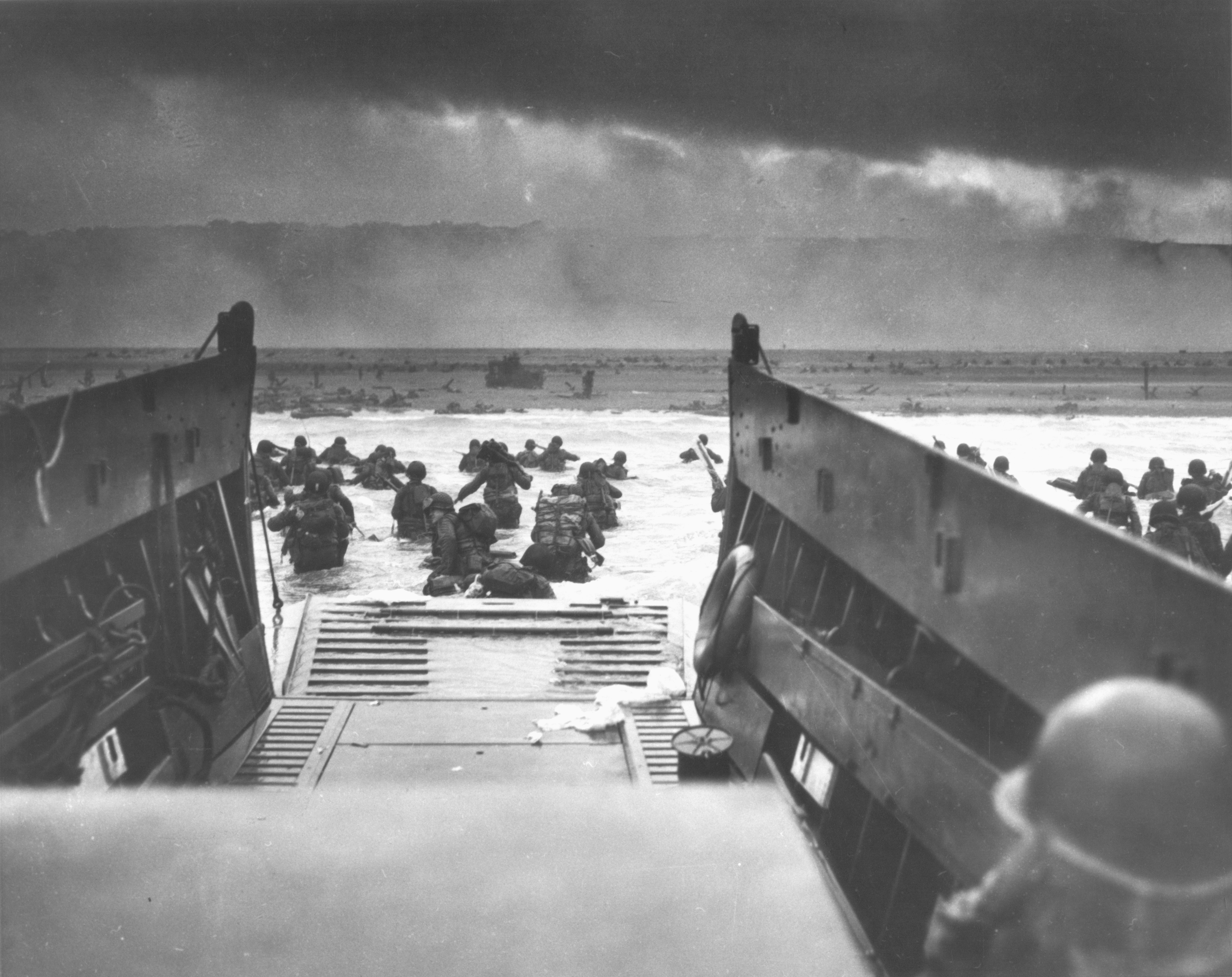
American Thinker reminds us that today is the 64th Anniversary of D-Day. I wonder how many young Americans know that, before D-Day, and barring some English-based bombing raids that did not involve “feet on the ground” fighting, America’s War had taken place entirely in the Pacific. Europe had been mostly stagnant: Hitler had taken over the entire Western part of the continent, and the Allies were unable to make a dent. It was the overwhelming sacrifices on those Normandy Beaches (with an estimated 10,000 dead and wounded in that single day) that gave the Allies a toehold in Europe and turned the tide of war.
To that generation and those men, I say, “Thank you.”
![]()
![]()

![]()
![]()
Email This Post To A Friend
15 Responses to “Remembering D-Day”
Leave a Reply
You must be logged in to post a comment.


Nice pictures Book. I’ll check back late afternoon as I have to go to the VA today.
http://www.miketrani.com/blog/index.php
Bookworm writes: I wonder how many young Americans know that, before D-Day, America’s War had taken place entirely in the Pacific. Europe had been stagnant: Hitler had taken over the entire Western part of the continent, and the Allies were unable to make a dent.
You seem to have forgotten that the US 8th Air Force, based in England, began bombing targets in Nazi-occupied Europe in 1942.
American troops were fighting in Sicily in 1943. The European theatre, in America’s War, was not stagnant until D-Day: far from it.
I just linked this. Also, I have a fairly extensive set of D-Day links up at my blog.
You’re right, Alex. I was thinking “feet on the ground” battles.
Bookworm, much as it grieves me to do this I have to tell you that you are badly mistaken. Europe was definitely not stagnant before D Day.
Just to summarize:
#The war in the Atlantic had been raging since before the U.S. had officially entered the war. While not technically “war in Europe” it was absolutely vital to Russian and British survival, and eventually to U.S. efforts in Europe.
#U.S. and British forces had defeated the Germans in North Africa. This was not an insignificant event in Europe proper for a number of reasons.
#In 1943 the U.S. and British invaded Italy; first through Sicily, and then the Mainland itself. Rome is considered to have fallen to the Allies on June 4, 1944. The Allies suffered upwards of 60,000 dead in the often overlooked Italian campaign.
#The U.S. strategic bombing campaign had been underway for quite some time. A major undertaking in which the U.S. suffered very high casualties. While this campaign fell short of many of its original goals it was a necessary prelude to invasion to achieve control of the air over Normandy.
I stand awe of the Normandy achievement. Nevertheless, one should never overlook the other efforts that preceded it, as well as though that were occurring in parallel.
By the way Book. I love those pictures. My father was a Navy crewmember on one of those landing craft during another significant invasion–Okinawa.
I have often wondered how the young men who had to face the beach when those ramps went down managed to function.
I should explain, Oldflyer. I know that stuff was raging around the core European areas. Indeed, my father was part of the North African campaign and my uncle was part of the Italian campaign (both in the British military). However, while the Allies had been bombing parts of Europe as a preparation for D-Day, the Nazis had an absolute grip on most of Europe, from Denmark to France and all points around and inbetween. There had been no ground battles — and this was, first and foremost, a ground battle war. In that regard — the death grip the Nazis had on Europe — and the fact that, aside from the random spies and parachuters, no Allied troops had set foot on European soil north of Italy, means that, as to Europe, the war was not fully engaged. Up until D-Day, it was still the Nazi playground.
Also, unless my chronology is truly screwed up, while I know the Russians were moving in from the East, that battle was still in the East. It hadn’t yet moved into Europe. So, while Europe was not untouched by Allied guns, boots and bombs, it was not a major theater of battle until the post D-Day era.
Bookworm,
If you haven’t seen it yet, the Tom Selleck movie “Countdown to D-Day” where he plays General Eisenhower is absolutely phenomenal. The entire movie from beginning to end is a work of love and is historically accurate.
I was watching part of it this morning before I realized I still had to go to work…
What an audacious moment in history. We send a continental invading force across the treacherous English Channel… through the eye of a gale! And we pull it off!
Even with making it across the Channel in one piece, the Germans should have torn us to shreds on the beaches and thrown us back into the sea. France of heavily fortified and the Germans didn’t have long logistic lines stretching across the Channel and then across the Atlantic.
If you looked at it on paper, we were outnumbered at least 16 to 1 every step of the way from Normandy into Germany. The Germans had better equipment, better technology on the ground. We should have lost.
There are so many “if’s” in this war it was incredible. If the British didn’t stop Rommel in North Africa, Hitler would have done the Southern Strategy and surrounded the oil fields and cut off our Lend Lease supplies to the Soviets through Iran. If the German commanding officers didn’t fly back to Germany before D-Day began, we might not have gotten a foothold on the continent (they figured, who’d be crazy enough to launch an invasion with a gale passing through the channel and lose an army?).
So many “what if’s”… And here we sit, the victors fifty years past. The question we might well ask ourselves is if such another calamity come in out lifetime, would we have the wherewithal to accomplish such feats today? Would Providence shine on us once more before the light of freedom is winked out?
Bookworm,
Sorry about the link screw up
Never argue with a woman.
But I won’t let it go so easily.
Please don’t tell an Italian that Europe only starts when you cross over the French or Swiss border. They really hate that; especially the Romans who still think that their ancestors brought civilization to the rest of the continent.
Don’t tell Bob Dole, or the tens of thousands of others who fought and suffered there, that the Italian campaign had no significance.
Don’t tell my boyhood hero, my older cousin who was sitting in the tail gunner’s position of a B17 in 1943 as he watched airplane after airplane spiral toward the ground, that he was in a stagnant situation. For God’s sake don’t say that to the families of the thousands and thousands of airmen of the 8th Air Force who paid the ultimate price. Unfortunately there were many 8th Air Force “boots on the ground” before June 1944; some of them survived the Stalags.
I know you wanted to honor D-Day, and that is worthy.
Oldflyer,
To your point, I believe the casualty rate for our bombers squadrons were in the 70-something percentile. That’s what happens when you do daylight strategic bombing. A whole lot of people and planes go down. The Brits, who used to pride themselves on their tenacity, couldn’t stomach the losses we took and resorted to nighttime bombing runs only.
While the war turned on D-Day, the largest amphibious landing force in all human history, there were many other moments where the war turned. I can think of no other war where so much depended on so many moments. Those who said that our victory was assured from the beginning, and even after D-Day, don’t know their history.
Eisenhower didn’t sweat D-Day. He sweated forcing the Rhine, where projected casualties were astronomic… even with air supremacy. Of course, as we all know now, Eisenhower didn’t have to force the Rhine after all. Eisenhower lured out Hitler by advancing on a broad front, which as bold as brass, if I may say. Thus, we have the Battle of the Bulge.
But to come out and field a entirely fresh army and conduct a surprise attack. Hitler had to strip his Eastern front of its seasoned officer core and had to pull the Luftwaffe from the Eastern front to prosecute the attack. The problem was, when he did so, the Eastern front began to collapse.
And this is what a near thing it was. Had Eisenhower failed in his gamble and lost the Battle of the Bulge, Stalin would have sued for terms. We have the documents proving that this was Stalin’s intentions, to observe the Battle of the Bulge. If we won, they would press into Germany. If we lost, they sue for terms.
Imagine Stalin suing for terms, and thus, freeing up the crack German divisions in the East and turning them West. Who knows what would have happened then?
I guess to me the difference with Italy, Oldflyer, is that it was under the control of the Italian fascists, and not the Nazis. They may have been allied with the Nazis, but they weren’t in that league.
When my Dad was in the desert, he became responsible for a lot of Italian soldiers who had surrendered to Montomgery’s forces. He adored his POWs. They planted flower-beds in the desert, cooked wonderful food, and were so grateful to be out of a war in which they had no interest.
My uncle, who served for a time in Italy, had exactly the same experience. The Italian civilians who found themselves under British military rule were delighted and delightful.
I guess that’s part of why I just don’t see Italy as part of Europe : the Italians simply weren’t as awful as the Nazis. And I say that despite knowing that the Nazis were in Italy and that the battles against them were as fierce and as terrible as anything the Nazis dished out in any other theater of War. Nevertheless, they didn’t “control” Italy. There ostensible presence there was to aid an Ally. (Of course, once they got their grubby paws on Italian soil, they immediately deported and mostly destroyed the ancient Italian Jewish population.)
I like this argument by the way, Oldflyer. With every one of your comments I learn more and have to wiggle harder to justify my original post. Eventually all my wiggling will fail, and my ignorance will be fully exposed. Apparently I’m having an Obama moment!
You get the last word.
I know we are arguing about semantics. My wife and I frequently discuss my obsession with the idea that people who have microphones (or blogs) have a greater obligation than most to speak precisely. Strangely for an English teacher she thinks I am a little over the top on the subject. I respond that even an old airplane driver, or maybe especially an old airplane driver, understands that careless speech has consequences.
Without question June 6, 1944 was one of the most momentous days in human history. I do hope it never loses its significance in the minds of Americans–and Europeans also.
You are too gracious, Oldflyer, especially since my imprecision (both in my history and the way I wrote this), left me appropriately open to challenges to my historic statements. So, my last words will be: thank you for keeping me honest.
I wonder how many young Americans know that, before D-Day, America’s War had taken place entirely in the Pacific.
Because France not only surrendered but actively cooperated in making the North Atlantic seaboard neigh impenetrable to British or American marine invasions, the brass decided they needed to start in Africa and work their way up through Italy. Once Hitler had divided up his forces to defend the Italians, Overlord would have a greater chance of success, not to mention the fact that you try invading with green and inexperienced troops and you’re not going to win, regardless of your tactical acumen or logistical savy.
Coincidentally, the first people Americans fought in America and Tripoli were the French. Kind of makes it hard for people to say that “France surrendered with honor” after giving their all in resisting the German blitzkrieg. Yeah, right.
D-Day ushered in the fight for French and German territories. Before then, all that was being done was laying the ground work. Such as subverting spies, like the one that convinced Hitler that Normandy was a decoy. Or the Italian campaign that drew off German forces to help their doomed allies.